Discovery sheet - Mercury
Mercury
The world of fire and ice
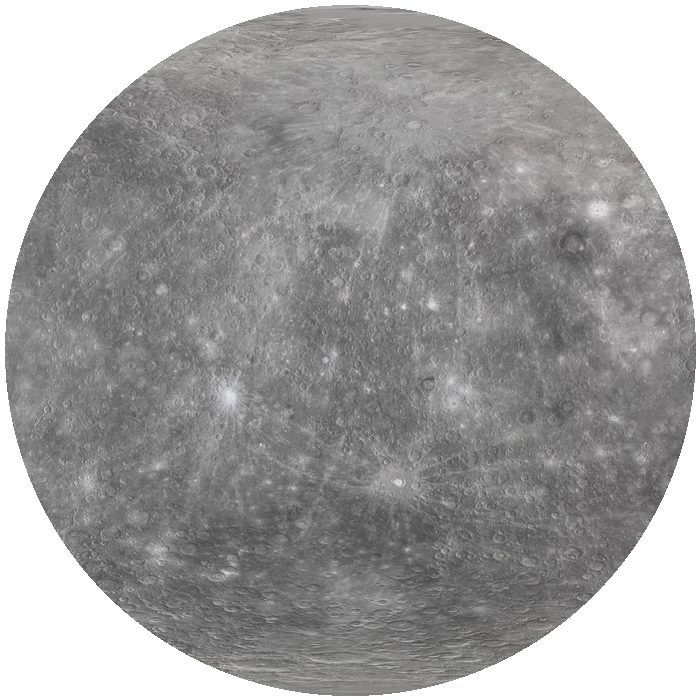
Illustrated globe based on a Solar System Scope texture (CC BY 4.0).
Mercury is the closest planet to the Sun. Its enormous metallic core, cratered surface and extreme temperature contrasts tell an ancient and violent story.
Type | Rocky planet |
|---|---|
Diameter | 4,879 km |
Mass (Earth = 1) | 0.055 Earth masses |
Average distance | 0.39 AU · 57.9 million km |
Orbital period | 87.97 days |
Rotation | 58.65 days |
Temperature | −180 to 430 °C |
Main orbiting bodies | No moons |
Compare with Earth
Its diameter is about 38% of Earth's.
Understanding Mercury
English learning edition - November 2026
Composition and interior
Mercury has a proportionally enormous iron-rich metallic core, surrounded by a relatively thin rocky mantle and crust. Craters and broad plains cover its ancient surface.
Atmosphere and environment
It has an extremely thin exosphere rather than a substantial atmosphere, containing oxygen, sodium, hydrogen, helium and potassium. Temperatures therefore vary greatly between day and night.
Exploration
Mariner 10 was the first spacecraft to fly past Mercury. MESSENGER then mapped the entire planet. The European-Japanese BepiColombo mission will study its surface, interior and magnetic field. It is scheduled to enter orbit on 21 November 2026, according to the schedule announced as of 12 November 2026.
A remarkable fact
Water ice can survive in permanently shadowed polar craters, despite Mercury's closeness to the Sun.
Sources and limitations
NASA Science: https://science.nasa.gov/mercury/facts/
ESA mission schedule: https://www.esa.int/articles/about-us/directorates/science/bepicolombo/latest-updates-bepicolombo-s-arrival-at-mercury
Online fact sheet: https://systeme-solaire-3d.fr/en/mercury
Values are rounded. The artistic view changes sizes and distances for readability. Check dated information before reusing it.
Test your understanding: Mercury
English learning edition - November 2026
Remember
• A year on Mercury lasts about 88 Earth days.
• It has the greatest day-to-night temperature differences of any planet.
• It has no moons.
Mini-challenge
Try first, then check the explanations below.
1. What type of celestial body is Mercury?
A. Gas giant B. Rocky planet C. G2 V star D. Ice giant
2. What is the approximate diameter of Mercury?
A. 6,779 km B. 50,724 km C. 4,879 km D. 1,392,700 km
3. What is the mass of Mercury compared with Earth?
A. 95.2 Earth masses B. 0.00218 Earth masses C. 1 Earth mass D. 0.055 Earth masses
Answers and explanations
1. Rocky planet. Rocky planets have solid ground; giant planets have deep fluid envelopes.
2. 4,879 km. A diameter measures a body from one side to the opposite side through its centre; it is twice the radius.
3. 0.055 Earth masses. Earth is the reference unit for this mass ratio. It does not describe a ratio of diameters or volumes.