Discovery sheet - Neptune
Neptune
A world of powerful winds
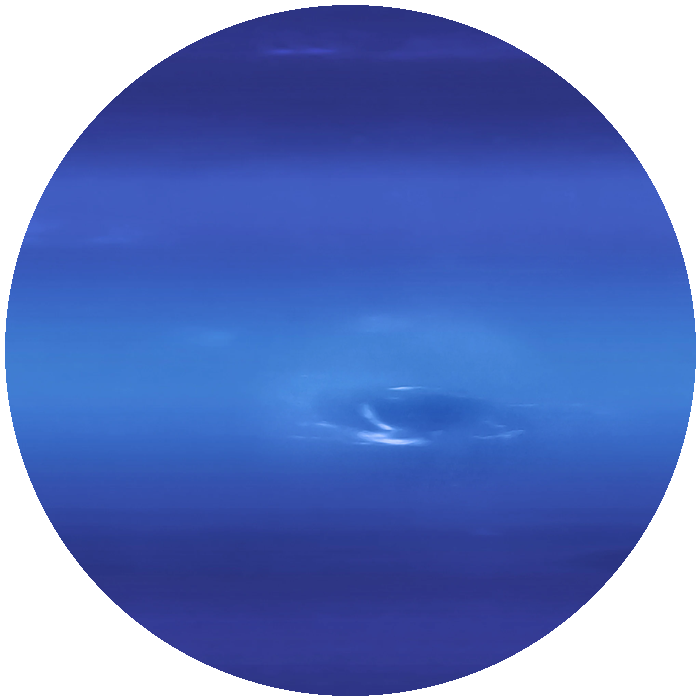
Illustrated globe based on a Solar System Scope texture (CC BY 4.0).
Neptune is the Solar System's outermost planet. Despite its distance from the Sun, its atmosphere has some of the fastest winds ever measured on a planet.
Type | Ice giant |
|---|---|
Diameter | 49,244 km |
Mass (Earth = 1) | 17.1 Earth masses |
Average distance | 30.07 AU · 4.50 billion km |
Orbital period | 164.8 years |
Rotation | 16 h 6 min |
Temperature | ≈ −200 °C |
Main orbiting bodies | Triton, Nereid and Proteus |
Compare with Earth
Sunlight takes more than 4 hours to reach it.
Understanding Neptune
English learning edition - November 2026
Composition and interior
Neptune probably has a rocky core surrounded by a deep mixture of water, methane and ammonia, beneath outer layers dominated by hydrogen and helium.
Atmosphere and environment
Its atmosphere also contains methane and has the fastest winds measured on any planet, sometimes exceeding 2,000 km/h. Dark storms appear and disappear there.
Exploration
Voyager 2 flew past Neptune in 1989 and remains the only spacecraft to have visited it. Hubble and James Webb now observe its storms, rings and seasons.
A remarkable fact
Triton, its largest moon, orbits in the opposite direction to Neptune's rotation. This retrograde orbit suggests it was once a Kuiper Belt object that Neptune captured.
Sources and limitations
NASA Science: https://science.nasa.gov/neptune/facts/
Online fact sheet: https://systeme-solaire-3d.fr/en/neptune
Values are rounded. The artistic view changes sizes and distances for readability. Check dated information before reusing it.
Test your understanding: Neptune
English learning edition - November 2026
Remember
• A year on Neptune lasts nearly 165 Earth years.
• Sunlight takes more than four hours to reach it.
• Triton is its largest moon.
Mini-challenge
Try first, then check the explanations below.
1. What type of celestial body is Neptune?
A. Gas giant B. Ice giant C. Rocky planet D. Dwarf planet
2. What is the approximate diameter of Neptune?
A. 1,392,700 km B. 12,742 km C. 49,244 km D. 139,820 km
3. What is the mass of Neptune compared with Earth?
A. 0.815 Earth masses B. 0.107 Earth masses C. 14.5 Earth masses D. 17.1 Earth masses
Answers and explanations
1. Ice giant. Rocky planets have solid ground; giant planets have deep fluid envelopes.
2. 49,244 km. A diameter measures a body from one side to the opposite side through its centre; it is twice the radius.
3. 17.1 Earth masses. Earth is the reference unit for this mass ratio. It does not describe a ratio of diameters or volumes.