Discovery sheet - Pluto
Pluto
The world with an icy heart
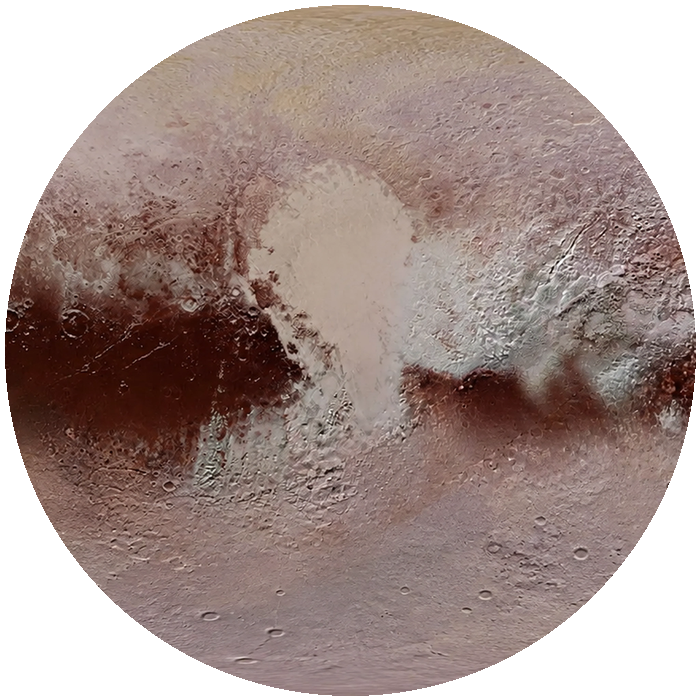
Illustrated globe: NASA/JHUAPL/SwRI map; unmapped area artistically reconstructed.
Pluto is a world of ice mountains, nitrogen plains and glaciers in the Kuiper Belt. Classified as a dwarf planet by the International Astronomical Union in 2006, it remains one of the most fascinating objects explored by New Horizons.
Type | Dwarf planet |
|---|---|
Diameter | 2,377 km |
Mass (Earth = 1) | 0.00218 Earth masses |
Average distance | 39.48 AU · 5.9 billion km on average |
Orbital period | ≈ 248 years |
Rotation | 6.39 days · retrograde |
Temperature | ≈ −232 °C |
Main orbiting bodies | Charon, Nix, Hydra, Kerberos and Styx |
Compare with Earth
Its diameter is less than one fifth of Earth's.
Understanding Pluto
English learning edition - November 2026
Composition and interior
Pluto is thought to have a rocky core surrounded by a water-ice mantle. Its surface includes frozen nitrogen, methane and carbon monoxide.
Atmosphere and environment
Pluto has a very thin atmosphere of nitrogen, methane and carbon monoxide. Some of these gases can freeze onto the surface as the dwarf planet moves farther from the Sun.
Exploration
New Horizons flew past Pluto in July 2015, revealing a world far more active and varied than expected: ice mountains, glaciers, atmospheric hazes and vast plains.
A remarkable fact
Sputnik Planitia forms the left part of the famous heart-shaped region. It contains moving ice and very few large craters, indicating a geologically young surface.
Sources and limitations
NASA Science: https://science.nasa.gov/dwarf-planets/pluto/facts/
Online fact sheet: https://systeme-solaire-3d.fr/en/pluto
Values are rounded. The artistic view changes sizes and distances for readability. Check dated information before reusing it.
Test your understanding: Pluto
English learning edition - November 2026
Remember
• Pluto has been classified as a dwarf planet since 2006.
• It belongs to the Kuiper Belt.
• Charon is its largest moon.
Mini-challenge
Try first, then check the explanations below.
1. What type of celestial body is Pluto?
A. G2 V star B. Gas giant C. Dwarf planet D. Rocky planet
2. What is the approximate diameter of Pluto?
A. 12,104 km B. 6,779 km C. 50,724 km D. 2,377 km
3. What is the mass of Pluto compared with Earth?
A. 0.00218 Earth masses B. 0.0123 Earth masses C. 95.2 Earth masses D. 332,946 Earth masses
Answers and explanations
1. Dwarf planet. A dwarf planet orbits the Sun but does not dominate its orbital neighbourhood.
2. 2,377 km. A diameter measures a body from one side to the opposite side through its centre; it is twice the radius.
3. 0.00218 Earth masses. Earth is the reference unit for this mass ratio. It does not describe a ratio of diameters or volumes.