Discovery sheet - the Sun
Sun
The glowing heart of our system
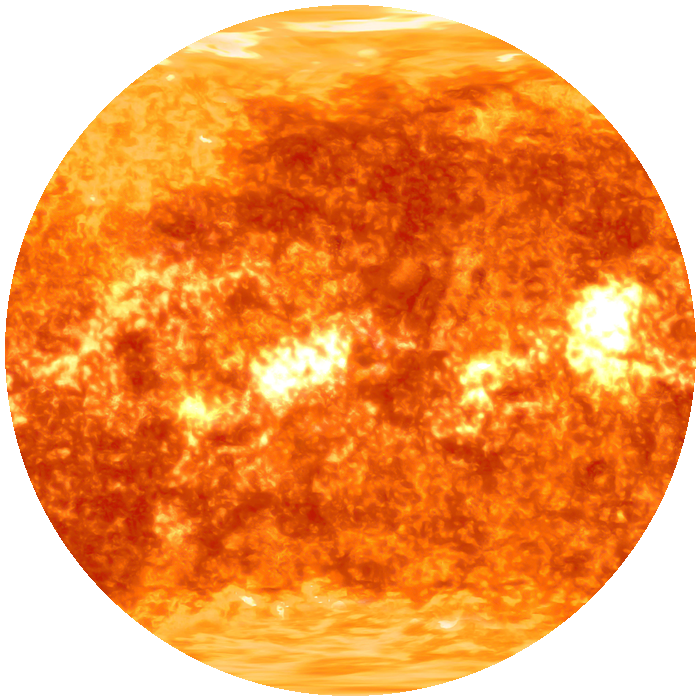
Illustrated globe based on a Solar System Scope texture (CC BY 4.0).
The Sun contains almost all the Solar System's mass. In its core, hydrogen fusion releases the energy that lights and warms the worlds around it.
Type | G2 V star |
|---|---|
Diameter | 1,392,700 km |
Mass (Earth = 1) | 332,946 Earth masses |
Position | Centre of the Solar System |
Orbital period | ≈ 230 million years around the Milky Way |
Rotation | ≈ 25 days at the equator · 35 to 36 days near the poles |
Temperature | ≈ 5,500 °C at the surface |
Planets | 8 planets orbit the Sun |
Compare with Earth
About 109 Earths placed side by side would span its diameter.
Understanding the Sun
English learning edition - November 2026
Composition and interior
The Sun is about 73% hydrogen and 25% helium by mass, with small amounts of oxygen, carbon, neon and iron. In its core, temperature and pressure allow hydrogen to fuse into helium.
Atmosphere and environment
The photosphere is the visible surface. Above it lie the chromosphere and the much hotter, extensive corona. The solar wind carries charged particles and shapes the heliosphere, a bubble surrounding the planets.
Exploration
Parker Solar Probe passes through the corona to measure particles and magnetic fields close to the Sun. Solar Orbiter observes its polar regions and the origins of the solar wind.
A remarkable fact
The Sun is not solid: its plasma rotates faster at the equator, taking about 25 days, than near the poles, where a rotation takes about 35 to 36 days. This is called differential rotation.
Sources and limitations
NASA Science: https://science.nasa.gov/sun/facts/
Online fact sheet: https://systeme-solaire-3d.fr/en/sun
Values are rounded. The artistic view changes sizes and distances for readability. Check dated information before reusing it.
Test your understanding: Sun
English learning edition - November 2026
Remember
• It contains about 99.8% of the Solar System's mass.
• Nuclear fusion is the source of its energy.
• Its light takes about 8 minutes 20 seconds to reach Earth.
Mini-challenge
Try first, then check the explanations below.
1. What type of celestial body is the Sun?
A. G2 V star B. Rocky planet C. Ice giant D. Natural satellite
2. What is the approximate diameter of the Sun?
A. 12,742 km B. 1,392,700 km C. 139,820 km D. 49,244 km
3. What is the mass of the Sun compared with Earth?
A. 0.107 Earth masses B. 14.5 Earth masses C. 332,946 Earth masses D. 0.055 Earth masses
Answers and explanations
1. G2 V star. A star releases energy by nuclear fusion in its interior.
2. 1,392,700 km. A diameter measures a body from one side to the opposite side through its centre; it is twice the radius.
3. 332,946 Earth masses. Earth is the reference unit for this mass ratio. It does not describe a ratio of diameters or volumes.