Discovery sheet - Earth
Earth
The blue oasis
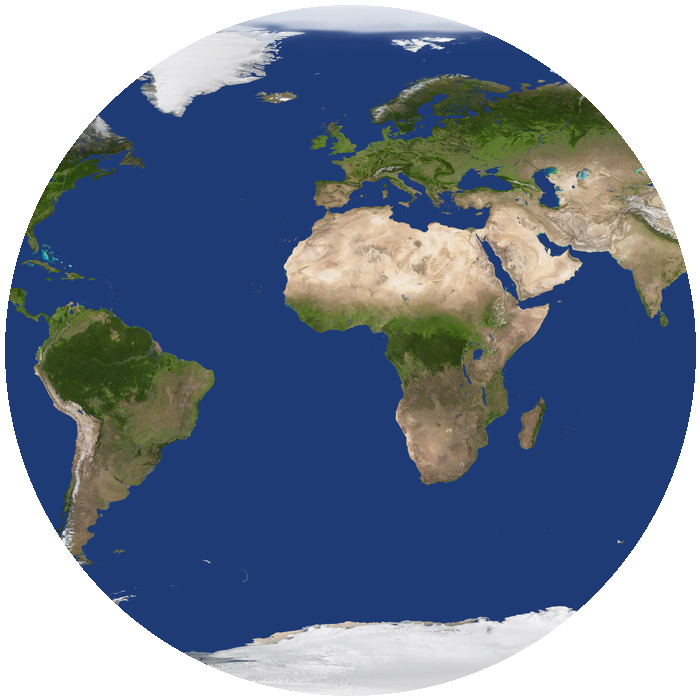
Illustrated globe based on a Solar System Scope texture (CC BY 4.0).
Earth combines stable liquid water, a protective atmosphere and geological activity that have allowed life as we know it to develop. Here it is the reference for sizes, masses and distances.
Type | Rocky planet |
|---|---|
Diameter | 12,742 km |
Mass (Earth = 1) | 1 Earth mass |
Average distance | 1 AU · 149.6 million km |
Orbital period | 365.256 days |
Rotation | 23 h 56 min |
Temperature | ≈ 15 °C on average |
Main orbiting bodies | The Moon |
Compare with Earth
Our reference for comparing other worlds.
Understanding Earth
English learning edition - November 2026
Composition and interior
Earth has an iron and nickel core, a rocky mantle and a crust divided into moving plates. Plate tectonics renews parts of the surface and contributes to the carbon cycle over very long periods.
Atmosphere and environment
The atmosphere contains about 78% nitrogen and 21% oxygen, with argon, carbon dioxide and water vapour. Oceans cover about 71% of the surface and play a major role in regulating climate.
Exploration
Thousands of satellites observe climate, oceans, ice and the atmosphere. The International Space Station maintains a continuous human presence in orbit and serves as a scientific laboratory.
A remarkable fact
Earth is the only world known to support life and stable liquid water on its surface. This does not prove it is alone, but no extraterrestrial life has yet been confirmed.
Sources and limitations
NASA Science: https://science.nasa.gov/earth/facts/
Online fact sheet: https://systeme-solaire-3d.fr/en/earth
Values are rounded. The artistic view changes sizes and distances for readability. Check dated information before reusing it.
Test your understanding: Earth
English learning edition - November 2026
Remember
• Earth is our reference for comparing other worlds.
• Its atmosphere protects the surface and regulates the climate.
• The Moon helps stabilise the tilt of Earth's axis.
Mini-challenge
Try first, then check the explanations below.
1. What type of celestial body is Earth?
A. Natural satellite B. Dwarf planet C. Gas giant D. Rocky planet
2. What is the approximate diameter of Earth?
A. 12,742 km B. 49,244 km C. 4,879 km D. 6,779 km
3. Which movement of Earth explains day and night?
A. Its orbit around the Sun B. Its rotation C. The Moon’s orbit D. The changing seasons
Answers and explanations
1. Rocky planet. Rocky planets have solid ground; giant planets have deep fluid envelopes.
2. 12,742 km. A diameter measures a body from one side to the opposite side through its centre; it is twice the radius.
3. Its rotation. As Earth rotates, different regions face the Sun and then turn away from it.