Discovery sheet - Jupiter
Jupiter
The giant of storms
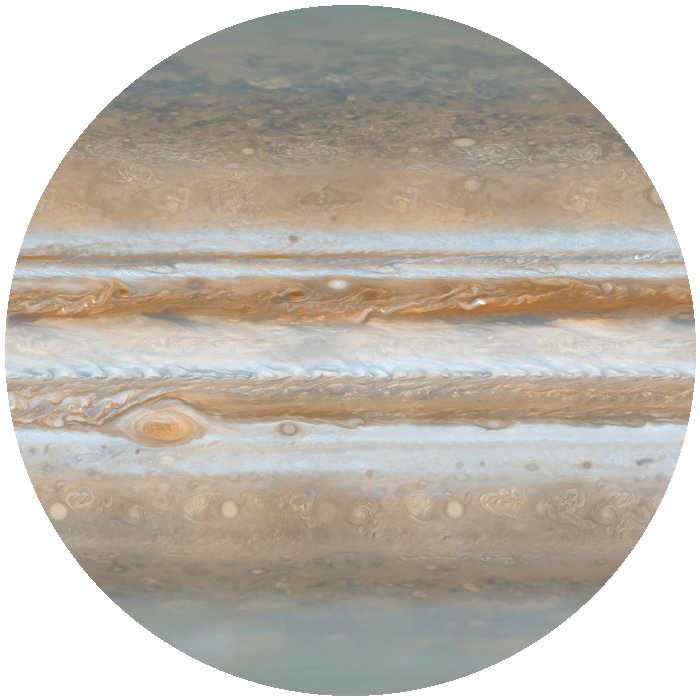
Illustrated globe based on a Solar System Scope texture (CC BY 4.0).
Jupiter is the most massive planet. Its Great Red Spot is an ancient storm larger than Earth, while its Galilean moons almost form a small planetary system of their own.
Type | Gas giant |
|---|---|
Diameter | 139,820 km |
Mass (Earth = 1) | 317.8 Earth masses |
Average distance | 5.20 AU · 778.5 million km |
Orbital period | 11.86 years |
Rotation | 9 h 56 min |
Temperature | ≈ −110 °C at cloud level |
Main orbiting bodies | Io, Europa, Ganymede and Callisto |
Compare with Earth
About 1,300 Earths could fit inside its volume.
Understanding Jupiter
English learning edition - November 2026
Composition and interior
Jupiter consists mainly of hydrogen and helium. Deep inside, pressure turns hydrogen into an electrically conducting metallic fluid around a probably diffuse core.
Atmosphere and environment
Its cloud bands contain substances including ammonia and water, and powerful winds sweep through them. Its immense magnetic field traps highly energetic particles.
Exploration
Juno’s observations have improved our understanding of Jupiter’s gravity, magnetic field and atmospheric structure. Europa Clipper is travelling to Jupiter, with arrival planned for April 2030, to investigate whether Europa’s ocean could provide conditions suitable for life.
A remarkable fact
The Great Red Spot is a storm observed for centuries and larger than Earth. In 1610, Galileo observed Io, Europa, Ganymede and Callisto, showing that not everything orbits our planet.
Sources and limitations
NASA Science: https://science.nasa.gov/jupiter/facts/
Online fact sheet: https://systeme-solaire-3d.fr/en/jupiter
Values are rounded. The artistic view changes sizes and distances for readability. Check dated information before reusing it.
Test your understanding: Jupiter
English learning edition - November 2026
Remember
• Jupiter is the largest planet.
• It spins once in less than ten hours.
• Ganymede is the largest moon in the Solar System.
Mini-challenge
Try first, then check the explanations below.
1. What type of celestial body is Jupiter?
A. Natural satellite B. G2 V star C. Gas giant D. Ice giant
2. What is the approximate diameter of Jupiter?
A. 3,474.8 km B. 50,724 km C. 1,392,700 km D. 139,820 km
3. What is the mass of Jupiter compared with Earth?
A. 317.8 Earth masses B. 95.2 Earth masses C. 0.00218 Earth masses D. 0.815 Earth masses
Answers and explanations
1. Gas giant. Rocky planets have solid ground; giant planets have deep fluid envelopes.
2. 139,820 km. A diameter measures a body from one side to the opposite side through its centre; it is twice the radius.
3. 317.8 Earth masses. Earth is the reference unit for this mass ratio. It does not describe a ratio of diameters or volumes.