SCIENTIFIC FACT SHEET · GAS GIANT
Jupiter
Jupiter is the most massive planet. Its Great Red Spot is an ancient storm larger than Earth, while its Galilean moons almost form a small planetary system of their own.
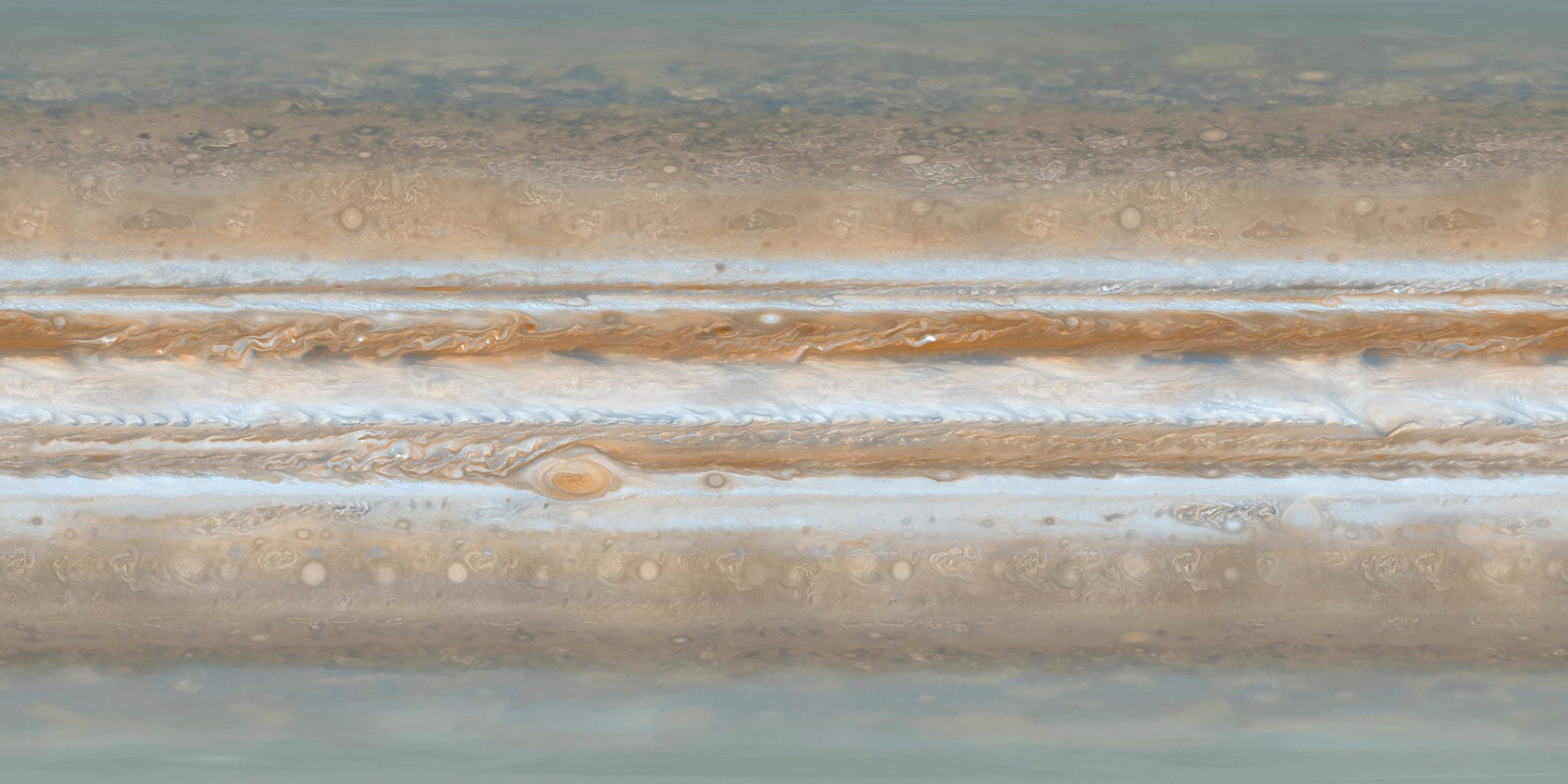
The giant of storms
Values are rounded for readability. The figures and 3D representation are explained in the Method section.
Composition and interior
Jupiter consists mainly of hydrogen and helium. Deep inside, pressure turns hydrogen into an electrically conducting metallic fluid around a probably diffuse core.
Atmosphere and environment
Its cloud bands contain substances including ammonia and water, and powerful winds sweep through them. Its immense magnetic field traps highly energetic particles.
Exploration
Juno has measured Jupiter's gravity, magnetic field and atmospheric structure. Europa Clipper is travelling to Jupiter, with arrival planned for 2030, to investigate whether Europa has conditions suitable for life.
A remarkable fact
The Great Red Spot is a storm observed for centuries and larger than Earth. In 1610, Galileo observed Io, Europa, Ganymede and Callisto, showing that not everything orbits our planet.
THE ESSENTIALS
Three things to remember about Jupiter
- Jupiter is the largest planet.
- It spins once in less than ten hours.
- Ganymede is the largest moon in the Solar System.