Discovery sheet - Mars
Mars
The red frontier
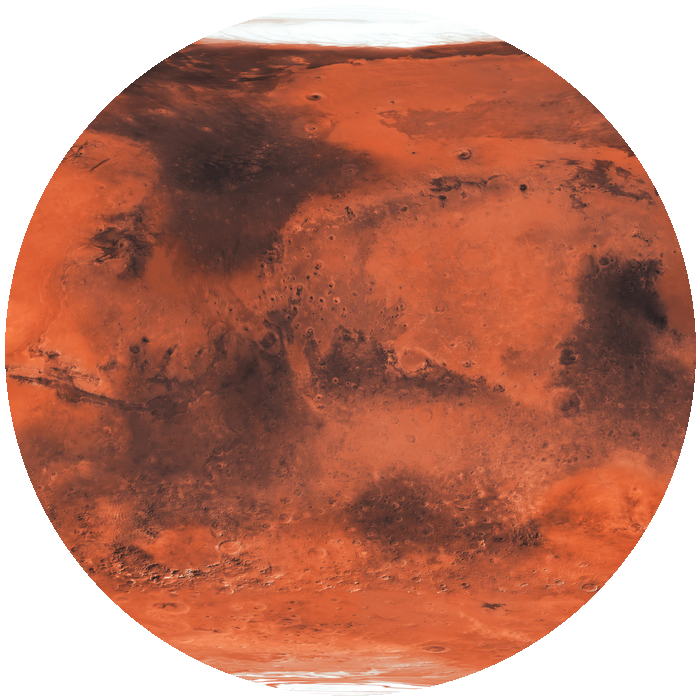
Illustrated globe based on a Solar System Scope texture (CC BY 4.0).
Mars has giant volcanoes, enormous canyons and traces of ancient rivers. Rovers and orbiters investigate conditions that might once have supported microbial life.
Type | Rocky planet |
|---|---|
Diameter | 6,779 km |
Mass (Earth = 1) | 0.107 Earth masses |
Average distance | 1.52 AU · 227.9 million km |
Orbital period | 686.98 days |
Rotation | 24 h 37 min |
Temperature | ≈ −63 °C on average |
Main orbiting bodies | Phobos and Deimos |
Compare with Earth
Its diameter is about 53% of Earth's.
Understanding Mars
English learning edition - November 2026
Composition and interior
Mars consists of basaltic rocks rich in iron oxides, a silicate mantle and a core containing iron, nickel and sulphur. Iron oxides give its dust a reddish colour.
Atmosphere and environment
Its very thin atmosphere contains about 95% carbon dioxide, with nitrogen and argon. Today's low pressure prevents liquid water from remaining stable on the surface for long.
Exploration
Perseverance explored Jezero crater, then its rim and the terrain beyond, collecting samples along the way. Curiosity studies Gale crater, while several orbiters map the planet, its buried ice and its atmosphere. Perseverance’s route was checked on 12 November 2026 against NASA’s report of 12 May 2026.
A remarkable fact
Olympus Mons rises about 22 kilometres above its surroundings, and Valles Marineris stretches for several thousand kilometres. Mars also bears traces of ancient rivers and lakes.
Sources and limitations
NASA Science: https://science.nasa.gov/mars/facts/
Online fact sheet: https://systeme-solaire-3d.fr/en/mars
Values are rounded. The artistic view changes sizes and distances for readability. Check dated information before reusing it.
Test your understanding: Mars
English learning edition - November 2026
Remember
• A Martian solar day, called a sol, lasts about 24 h 40 min; its sidereal rotation takes 24 h 37 min.
• Mars once had liquid water on its surface.
• Its two small moons are called Phobos and Deimos.
Mini-challenge
Try first, then check the explanations below.
1. What type of celestial body is Mars?
A. G2 V star B. Rocky planet C. Ice giant D. Natural satellite
2. What is the approximate diameter of Mars?
A. 12,104 km B. 139,820 km C. 6,779 km D. 49,244 km
3. What is the mass of Mars compared with Earth?
A. 0.0123 Earth masses B. 14.5 Earth masses C. 332,946 Earth masses D. 0.107 Earth masses
Answers and explanations
1. Rocky planet. Rocky planets have solid ground; giant planets have deep fluid envelopes.
2. 6,779 km. A diameter measures a body from one side to the opposite side through its centre; it is twice the radius.
3. 0.107 Earth masses. Earth is the reference unit for this mass ratio. It does not describe a ratio of diameters or volumes.