Discovery sheet - Venus
Venus
The planet of acid clouds
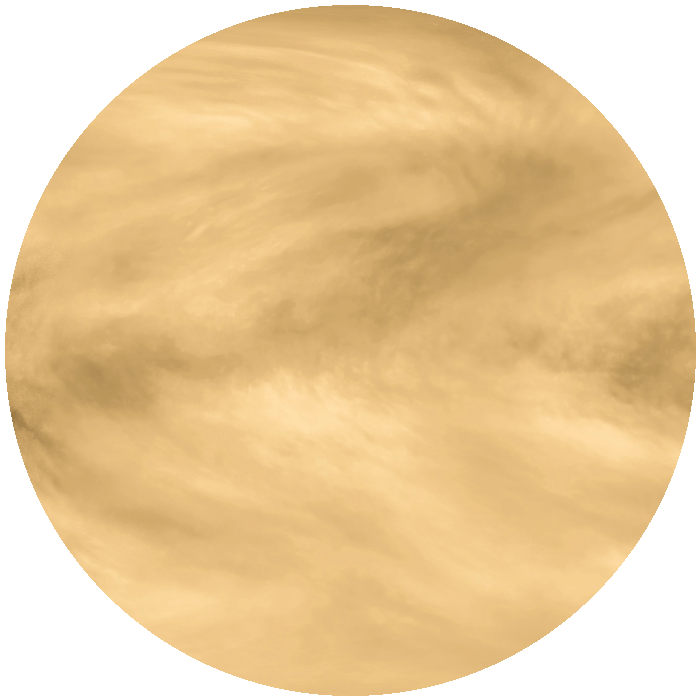
Illustrated globe based on a Solar System Scope texture (CC BY 4.0).
Beneath its sulphuric acid clouds, Venus hides a rocky world with an extreme greenhouse effect. Its slow, retrograde rotation makes it one of the most unusual planets.
Type | Rocky planet |
|---|---|
Diameter | 12,104 km |
Mass (Earth = 1) | 0.815 Earth masses |
Average distance | 0.72 AU · 108.2 million km |
Orbital period | 224.70 days |
Rotation | 243 days · retrograde |
Temperature | ≈ 465 °C |
Main orbiting bodies | No moons |
Compare with Earth
Almost as large as Earth, but hotter than Mercury.
Understanding Venus
English learning edition - November 2026
Composition and interior
Venus is a rocky planet similar in size to Earth. It probably has a crust, a silicate mantle and a metallic core. Many volcanoes and lava plains mark its surface.
Atmosphere and environment
Its atmosphere contains about 96.5% carbon dioxide, nitrogen and sulphuric acid clouds. Surface pressure is nearly 92 times Earth's, and the greenhouse effect keeps temperatures near 465 °C.
Exploration
The Soviet Venera probes sent back the first images from the surface. Magellan mapped the terrain with radar. DAVINCI, VERITAS and EnVision are planned to investigate the history of its atmosphere and geology.
A remarkable fact
Venus rotates very slowly and in a retrograde direction. A Venusian sidereal day lasts longer than its year around the Sun.
Sources and limitations
NASA Science: https://science.nasa.gov/venus/facts/
Online fact sheet: https://systeme-solaire-3d.fr/en/venus
Values are rounded. The artistic view changes sizes and distances for readability. Check dated information before reusing it.
Test your understanding: Venus
English learning edition - November 2026
Remember
• Venus is the hottest planet.
• Carbon dioxide dominates its atmosphere.
• It has no moons.
Mini-challenge
Try first, then check the explanations below.
1. What type of celestial body is Venus?
A. Dwarf planet B. Gas giant C. Rocky planet D. G2 V star
2. What is the approximate diameter of Venus?
A. 116,460 km B. 2,377 km C. 12,742 km D. 12,104 km
3. What is the mass of Venus compared with Earth?
A. 0.815 Earth masses B. 17.1 Earth masses C. 0.055 Earth masses D. 0.107 Earth masses
Answers and explanations
1. Rocky planet. Rocky planets have solid ground; giant planets have deep fluid envelopes.
2. 12,104 km. A diameter measures a body from one side to the opposite side through its centre; it is twice the radius.
3. 0.815 Earth masses. Earth is the reference unit for this mass ratio. It does not describe a ratio of diameters or volumes.